Tuesday, June 27, 2006

A lot going on, but wanted to share this

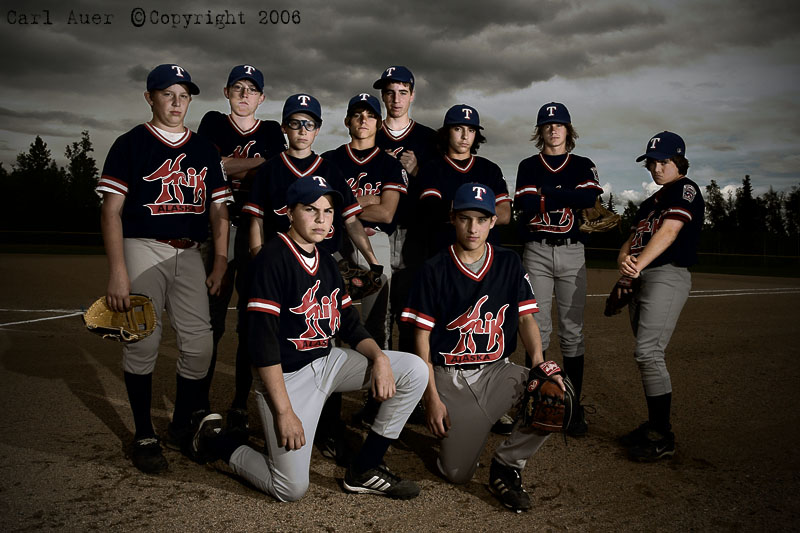
I have been extremely busy as of late (hope that will turn into $$ for once) and it looks like I will be even more busy over the next couple weeks. But I did a team photo I wanted to share with you all.

Those of you who know me well realize I absolutely hate standard team and individual photos. A photo that anyone else could have shot really does not interest me when it comes to portraits. I will do them if I have to, but if it is up to me, I would do them my way and make them fun for the kids, parents, and myself. I kind of go started doing this last year a little with the local high school basketball team, but due to conflicts with practices and uniforms, I did not get to do them all the way I wanted to. During the baseball season, usually the only team photo I take is the after championship game photo, and many times I will not do that because every parent out there will have a camera and I will not sell any.

Now do not get me wrong, I know T&I (team and individual) is a great business, but if I am not having fun and the parents or kids are not really interested in what I am producing, why do it. So, the little league I shoot for has a studio that does the team pictures each season, but they did a crummy job scheduling, and a bunch of the teams could not make their appointments because they were scheduled during games or right between double headers (most parents do want clean uniforms for their kids pictures). One of the juniors teams was one that did not have a team picture. On of the parents asked me to shoot one for them. She is a great customer, so I knew I would sell at least one, so I said sure. I got word to the coach that I was going to shoot a team photo and I needed them to show up 1 hour before the game. I showed up about 15 minutes before I expected the team, and I figured the team would not all show up until 30 minutes before the game, so that would give me time to set up my lights on lightstands, take some readings, and go. The field is an ok location to shoot, but where I normally would have the team stand, I now have parents and siblings filing into the seats in frame. The other team wants to take warm ups on the field, so the ump had me move my gear. 30 minutes before the game, not one member of the team is there. Clouds are rolling in, and my mind is racing. So I decide, I will have them stand, facing the fence....I throw my speedlights up onto the fence and meter it. I have some ok exposure going, but the dark clouds are really rolling in and still no team. 5 minutes before the game starts, here they come...the whole team is there and I grab them. The coach yells at them "Come on Thugz, time for a team photo!" Thugz? Yup that was what they named themselves this season...I look at the clouds, I look at them, and it hits me. I tell them that I do not care how they stand, backs to me, sides, what ever, but look tough and if you can not see the camera lens, then move until you can see it clearly. I bumped my flash out put up 2 stops (in Canon's ETTL mode) set the 17-40 at 17mm on the 1D and changed my exposure on the camera to make those dark clouds even darker. A little bit of photoshop work and I ended up with my most popular team photo ever. Not everyone likes it, but the majority do and the entire team and their parents do, so that makes it a winner for me.
Wednesday, May 31, 2006

Full Frame Myth

I get a lot of emails asking me about lens choices. Some people get so confused. I was recently asked what the best portrait lens was in a specific price range. I responded that the 85mm 1.8 is a great choice. The reply was, well, with my camera, that would make it a 136mm lens, and that is too long I think. That got me to thinking.....it has been hashed out on internet forums, magazines, trade shows over and over again, but no one is grasping it correctly. Your camera does NOT change the focal length of a lens.

There is a lot of talk about Full Frame cameras. I hate to be the bearer of news that will go against what everyone in the world has believed in for so long, but all Digital SLR cameras are full frame. They may just not have the same size frame. There are 35mm sized sensors, there are APS-C sensors, there are sensors between 35mm and APS-C, there are sensors smaller, there are medium format sensors that are much larger than even a 35mm sized sensor. But they are all full frame. Now a few, some of the newer offerings from Nikon (D2X) and from some smaller companies that do, in effect, crop the sensor some. The D2X does this to improve speed. It's APS-C sensor is cropped down to a lower resolution and this increases the frames per second it can shoot. There are new cameras that will adjust the crop of the sensor to give you a HDTV orientation, or a 4x3 or a 5x7 crop. But none of these effect your lens focal length.

Before diving into digital "lens conversion", let's look back at film. As digital was emerging, there were two main consumer film sizes. APS and 35mm. APS was not as popular, and actually looked to be dying, and 35mm had been the standard for so long. The step up from 35mm was medium format. For this story, we will look at the 645 size, or 6cmx4.5cm.

Every camera type had a standard lens. With 35mm, the normal lens was a 50mm. If you kept both eyes open, it was very close to equal what you saw through the camera and with your naked eye (45mm was almost the exact as the naked eye). But you put a 50mm lens on a APS camera, things appeared bigger. Not really. The size of the film is not as big as the size of a 35mm frame, so the view you got was actually coming from the center portion of the lens. In effect cropping the lens. But....it was still a 50mm lens. You put a 50mm lens on a APS camera, it was what you expected. Now put a 50mm lens on a medium format camera and it acts as a wide angle lens. It will show much more area than on a 35mm frame, but it is still a 50mm lens. If you wanted an image to look the same from camera format to camera format, on your APS camera, a 35mm would be a good choice, 50mm for 35mm, and 80mm for medium format, but the lens focal lengths do not change.

In the digital age, that is the same. So you have an Olympus system that states 2x lens conversion. Incorrect. The frame is smaller than a 35mm frame, but it is not magnifying the lens at all, so a 100mm lens is still a 100mm lens, but compare a shot from an Olympus E-300 to that of a Canon 1Ds with a 200mm lens on it, you will at first think, that the Olympus really is doubling the lens. But it is not. The 100mm lens is acting like a 100mm lens from telephoto compression to DOF. What is commonly known as Field of View Crop, which is close to accurate, the smaller sensor is only using part of the lens. Now some manufacturers have made lenses that take this into account, but they are not "new" lenses. In fact, they are the same type lenses that were made for film cameras, but ground down to a smaller physical size. This makes them smaller and lighter and unusable on cameras with larger sensors. What makes a 50mm lens a 50mm lens is the fact that a certain part of the lens is 50mm from the sensor or film plane. So, if you could cut your lens and camera in half and measure from a specific point in the lens to the sensor you would find it the same distance in mm as your lens focal length. It does not matter what lens or what camera. On a 1Ds, a 30D, a Rebel Xt, a 50mm lens will always measure 50mm. So when you throw that 300mm lens on your Rebel, do not think that you are effectively shooting a lens that is 480mm. Your 300mm lens is still just a 300mm lens.

Thursday, May 25, 2006

A New Blog coming soon

Well, my personal project is off and running, so far with only one client. But, I am going to be working on setting up a new blog specifically for my personal project. PhotoBag will keep going, but the still to be named blog will specifically target things to do in the Eagle River, Alaska area. From clubs, to recreation, to what to do on a Friday night, and the likes. I hope to have something new posted to it once a week. So, stay tuned.

Thursday, May 18, 2006

Personal Project - The Start


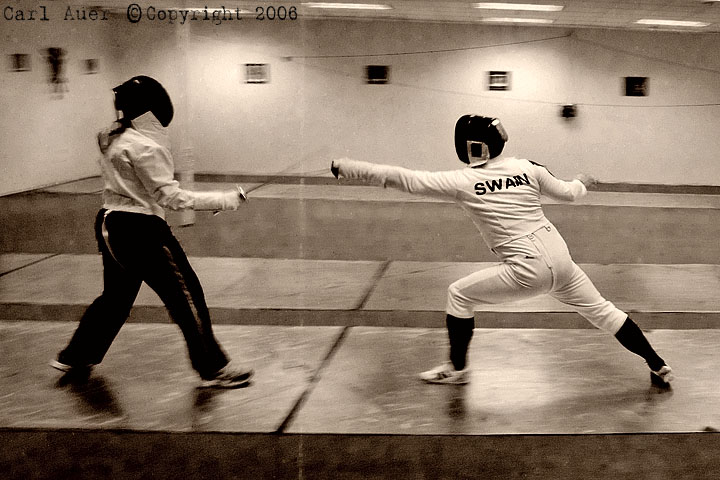
I have started my long and big personal project. Last night I visited the Eagle River Fencing Club to take some test shots and get some ideas for my main shoot there over the next few weeks. I am also working with a new Photoshop technique that can give photos an old, film like look. I applied the process to this test image because with fencing being an old world sport, I thought the old film look worked with it.

Digital Fix Myth

Back in the days before digital cameras and Photoshop were common to everyone, when you bought a lens, you dealt with what ever characteristics the lens had. If it was a wide angle, you lived with the way it could distort images. If it was a super telephoto, you could see some distortion sometime known as barrel distortion. But when shooting film, people lived with it. Now with digital and Photoshop, everyone seems to want to fix these "flaws" where in reality, you are not making your image any better. Once you decide to remove a WA pincushion look to an image, or fix barrel distortion, you now have an altered image. Let's say you take a photo of some newsworthy event with a wide angle or fish eye lens, you captured the moment, but before you try to sell it to a newspaper, you run it through Photoshop and you slightly adjust contrast, color and sharpening. Fine. 99.9999% of the pro media shooters do this and it is an accepted practice, but you do not like the effect the wide angle lens did to people in the photo away from the center of the photo? No worries, run it through a Photoshop lens correction filter, or DxO labs plug in and you are good to go, everyone is straight, and the scene is just like you saw it with your naked eye. Wrong. This is now an altered image. While minor adjustments to color or contrast are accepted, physically changing the image with a third party plug in like this is not acceptable. You now have a computer altered image. It would now be unethical to try to sell this as a news image. It is fine for people doing art prints, landscapes and the like, but for news photos, no way. Do not alter an image beyond what you could easily do in the darkroom with film. Levels and contrast or curves is the equivalent of how much light you give your negative when printing it. Cropping is basically the same, although should be used on a very limited basis and never to purposely crop something relevant to the story out. Color can be determined with the film you used or paper you printed on, so color adjustments, again, lightly, are fine. Sharpening or USM is similar to focusing the enlarger. Anyone with basic film darkroom experience can do this and you can easily do this in Photoshop, but to physically change the way your gear captures a scene is not right. If you captured it with a wide angle lens, then you should understand that any pincushion effects it may have caused is normal and should be left alone. Live with it. Learn how to use your gear to lessen the effects like this. Do not get into the idea or mind set that you can fix it later in Photoshop, because you are no longer a photographer then, you are now a digital artist.

Monday, May 15, 2006

Touching base on Personal Project

I had a meeting this last weekend that should get my personal project rolling. I actually have come up with some interesting ideas too to go along with it. This week I will be checking out a local Fencing Club (not white picket, but actual swords) and next week I will be photographing both the club and the school.

As I said in a previous post, I want to show people new to Eagle River, as well as people who have lived here for a while, all there is to do in our small town. That there is no need to complain, or sit at home because there is just nothing to do around town. Clubs, groups, and organizations are one of the things I want to focus on, and will probably be my first set of photos I do. My project is going to consist of activities, food, church, entertainment, etc.

Originally I had the idea that I would put together the photos and search out someone to print it and sell it. Now, I think what I will be doing is putting together a blog, for Eagle River activities and each week try to add something new. I am hoping to have the local paper also participate by running a photo a week or at least a month on one of these fun or little known events.

Once I feel it is near completion, I want to put all of the info onto a interactive CD and distribute to local churches, Realtors, visitor centers, etc. Kind of a welcome to Eagle River deal. Included in the CD will be coupons from local businesses profiled on the CD (advertising to help pay for this). I am real excited to get a chance to do something like this. It is going to be a long, hard run putting it together, but it should keep my busy.

Friday, May 05, 2006

Sweet Georgia Brown

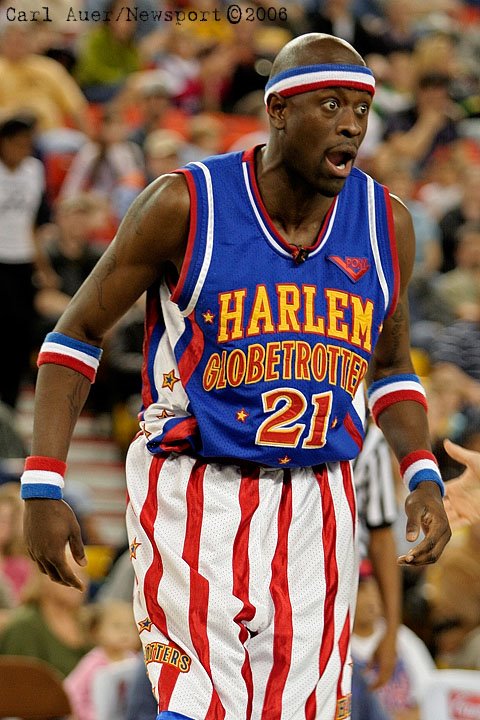
After a 10 year absence in the State of Alaska, the Harlem Globetrotters made their way into the Sullivan Arena in Anchorage, Alaska on Thursday the 4th of May.

Globetrotter Kevin "Special K" Daley reacts to a call made by the refs during the first of two games in Anchorage.


Monday, May 01, 2006

Bird Flu

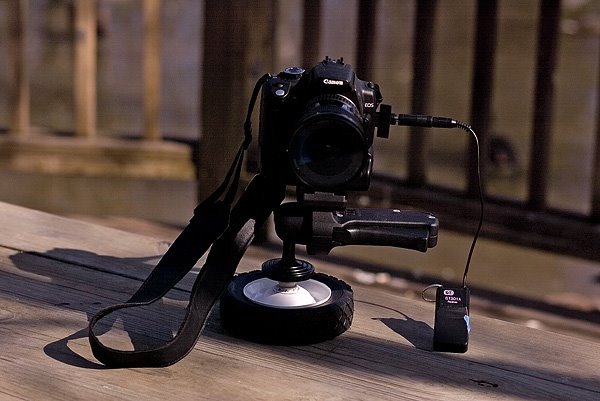
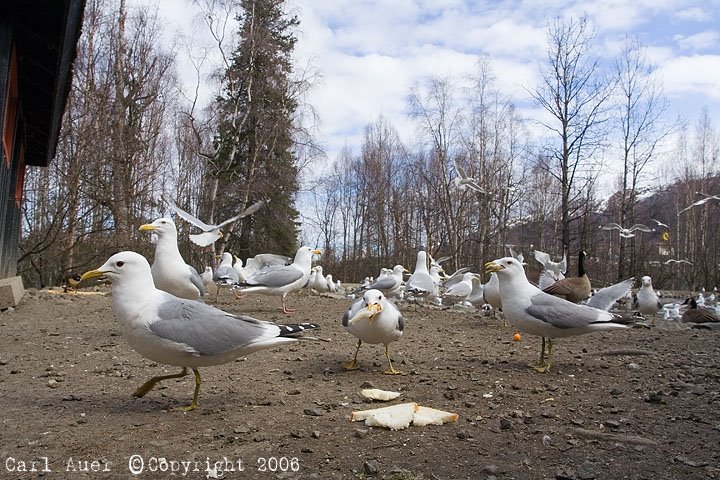
Working on a media project on bird flu in our local waterfoul public feeding areas gave my remote Xt a work out. Here is the set up that I talked about in a previous post.

As you can see, I hooked my ball head (Bogen grip tripod head) to a small wheel. For larger lenses, I may look at a larger wheel for more stability, but with the 17-40 and the Xt, it works pretty well.


Bird Flu

In 1918, 87 years ago, 72 people died in Brevig Mission after a pandemic caused by bird flu occurred. In fact, tens of millions of people died from this version of the avian flu. This is something that we all do not want to see happen again. While scientists are studying the current H5N1 strain to figure out a way to contain it, a little common sense and taking precautions can go a long way in protecting yourself if you come in contact with wild birds.

As a photographer in Eagle River, I thoroughly enjoy visiting our local water fowl viewing location, the duck pond at the Duck Pond Car Wash. There are many different species that make up the year round residents of the duck pond. Dozens and dozens of male and female mallards, domesticated ducks, geese of many flavors, peacocks, various chickens and their furry friends, those long eared bunnies. These by themselves seem harmless, with the exception of the geese who find it fun to try to bite your fingers as you feed them. The ability to get so close to these animals even as domesticated as they are, is great for photography. And this is part of the draw of any duck pond. But this can also be a drawback for health and safety. Even with a daily cleaning or the visitors area, birds are not clean animals. They stand on the railings, picnic table, and boardwalks, and unlike humans, when they feel the need to go, they go. Then, as spring rolls in, these friendly, fun critters are joined by temporary guests, which include Canadian Geese and hundreds of Seagulls, including my favorite, the Bonaparte Gull. This infusion of truly wild animals and domesticated animals can cause a major problem if even one of the new residents is carrying the dreaded bird flu.

The H5N1 Bird Flu, which is mainly found in Asia, greatly in regions of China, is becoming widespread with cases reported as far away as Nigeria and Scotland. It is only a matter of time before this virus makes its way to the United States. Experts predict that the far west coast of Alaska, around the city of Nome and villages like Brevig Mission will see the first signs of the flu. Thinking of how far the Canadian Geese fly on their seasonal migration, it is only a matter of time before it makes its way through the state and into our back yards and to the duck pond. In Asia, the unfortunate answer to the bird flu is to kill all the birds in areas where the flu is found. Domestic, farm, wild. Anything that might continue the disease is destroyed. Eradication is currently the only answer until scientists come up with a cure. Not all birds are carrying the bird flu, but there is no telling what any of these birds may be carrying.

I do not want to tell anyone to stay away from their local duck pond in fear of getting sick, but you can take precautions to make sure you and your loved ones stay safe. Using a little common sense can go a long way in protecting you and your loved ones. If you are taking a lunch to the pond, take a table cloth with you and have pleanty of wet naps with you. The birds have the run of the place and while the picnic tables are kept pretty clean, you never know when any one of the birds may have decided it was a great place to use as a out house. Have a small bottle of hand sanitizer with you and clean your hands after you feed the animals. Keep the urge to pet the “tame” water foul in check. I have seen many times a young child excited about touching the pretty feathers on the birds and then sit down for their happy meal. Not only is this a good idea to prevent the possibility of picking up something that you may not want, but I have found out the hard way, these birds bite.

Flu or no flu, just keeping yourself clean is always a good idea after coming in contact with outdoor animals. Also, if you have any suspicions that a bird is infected with the bird flu or some other disease, contact your local authorities as soon as possible.

Wednesday, April 26, 2006

Inexpensive Remote Camera Set Up

No pictures to go along with this post yet, but they will be coming soon.

So, you want to shoot some remote shots this summer of baseball or soccer, maybe some track and field but have no clue how to do it? Well you can for around $10,000. Whoa....I know what you are saying. "I thought this was suppose to be inexpensive!" Well, just wait. The ideal remote set up would be a 1Ds series camera, a lens (depends on what you shoot), a floor mount and ball head, triggering wire, pocket wizard, maybe a dust cover or rain cover. You want the 1Ds series for the wide angle. Low angle shots look great with a wide angle lens. Just think of a camera right at the back of a soccer goal capturing a laid out goalie reaching for a ball with the shooter and defenders in mid action, or a long jumper taking off from the line exploding for a huge take off. Set it up, prefocus, hook up a pocket wizard, set up in your normal shooting position and fire away. Shot comes up in your remote location, grab the pocket wizard and trigger the camera. Bam. Easy, huh?

So you do not have $10000 to drop on a remote set up? Ok...how about around $1000? Less than that if you already have a second camera in your arsenal. Taylor this to your own needs, but this is what I am am using for a remote camera set up.

One Digital Rebel Xt. Not a full frame camera, but it is small, light, and cheap as DSLRs go. For a floor mount, I am using of all things, a small wheel barrow wheel. Wal-Mart sells these for about $3. I picked up the axle bolt that goes along with it for about $1 more. This bolt just happens to be the same size as a camera tripod ball mount socket. 1/4". put this together and you have a pretty sturdy mount for a camera at about 8" to 12" off the ground. On the Rebel, depending on the sport, I will mount a 17-40 up to a 70-200 lens. You could get away with using the 10-22 EF-S lens if you have it. Ok. The camera is ready...now, how do I trigger it? I am using single channel radio slaves I got from ebay. Spent about $30 on them. They are not the best, and now come in 4 and 16 channel versions. The receivers are about 3.5" long and around 1.25" wide and run on 2 AA batteries. Plug the phono plug into the miniplug adapter and plug that into a miniplug to 3/32 miniplug adapter. Now prior to hooking this to your camera, you need to make sure your camera is set up to shoot. Shoot in manual (hand held meter is handy to set exposure) have the camera set to "burst" mode and set the focus. Put the lens into MF mode. Now, plug the 3/32 plug into the cable release port on the camera, and you are good to go. Not the range of a pocket wizard, but if you have the camera set up at home plate looking up to 3rd base and you are shooting from around 3rd base or 1st base, you should be able to trigger it no problem. Even though the camera is set to "burst", it will only shoot one frame each time you trigger it. Holding the transmitter button down will not keep shooting. However, if you are shooting with a second camera, and do not mind a lot of extra junk frames, put the transmitter onto your hotshoe and every time time you take a picture, the remote camera will fire. Now if you are shooting with a 1D series at 8fps and using a Rebel for a remote, for every 8 shots you take consecutively, the Rebel will only shoot at 3fps.

I will be posting some test shots this weekend. I will be using this set up for a special feature assignment. So more to come.

Monday, April 17, 2006

Personal Project

Even with baseball season in Alaska quickly approaching, the Globetrotters on the near horizon, and a few other for pay projects coming up, I have started work on a personal project. I hear a lot of people feel there is nothing to do in Eagle River, that we just do not have anything going on out here. My project over the next year will be to photographically document businesses in the Eagle River area. My goal is to not only photograph the hot spots of Eagle River, but the little known hangouts, the different businesses in the area that offer all different kinds of services, and so much more. My goal is to either have the Eagle River/Chugiak Chamber of Commerce publish the photos in guides to the area or have the Alaska Star run a weekly spotlight of businesses and service providers in the area. If you are a business owner in the Chugiak/Eagle River area and would like to assist me with this project, please contact me via email at carlauer@gmail.com

Setting Up Youth Sports Galleries

Reposted from a post I made at www.fredmiranda.com

With little league upon most of us, I thought I would start this thread to give tips for those of us who shoot an sell online. I bring this up today because I recently have had three or four people ask me to look at their online galleries. All of them needed help, but one stood out as it required me to click 5 times after opening a gallery to view just the first image. When I was done, I had 6 pop up ads and a new friend lurking around in my computer that ad-aware had to find for me. The one gallery I looked at had 273 photos and the first two pages were of the pitcher throwing only three pitches. Ok, so if my kid is playing left field or hitting 6th in the order, and I am on page three now and have not seen anything but one player so far, I get board real quick.

Now these are just some of my tips. I encourage those of you who do sell online to share some of your tips that make things easier for you.

First things first. Have permission from the league prior to shooting a game and posting images. While games may be played on public fields, it is not ok just to start shooting and selling without the officials giving the ok. Never add information about the players on the site like names or addresses (duh!) and respected the wishes of anyone who wants their child's photo taken down. Have password protection of your galleries as an option in case parents or the league asks for it.

For youth sports, I find a mix of action and sportraits work great. As Paul said in one of his posts recently, go tight. Be sure your images are coming out of the camera properly exposed with correct WB and in sharp focus. Try your best to get your horizons straight and compose so you do not have to crop. Lenses are not long enough to reach the center fielder? Shoot an inning down the line in the outfield area then. If your lens will not get you the shot, then move to where it can.

When you download your images, take the time to go through and delete your junk photos. Missed shots, OOF, etc. etc. Please, do not post these. When I shoot 3 games in a day, this step alone can take only about 5-10 minutes. If you download correctly, you should be saving your images to two places (at least that is how I do it). One set to archive and one to work from. So as you delete, your archived originals are not being touched.

After you have done the first quick edit. I like taking the photos from each game and putting them in their own folder. I then go through again and tag the best shots to post. If I shoot 300 photos in a game, I will post anywhere from 40-80. Yes, I could post more, but why make the parents go through photos that look the same? With a 20D or 30D, you are looking at 5fps and with the 1D series, 8fps. So you shoot off a burst of the pitcher throwing, and again, and again. So you have up to 24-30 photos of the kid throwing 3 pitches. Do not post all of them. Pick your best shot from the wind up, the apex of the throw, and the release and post only those. Same with batting. Kids tend to swing the same over and over again, so, while you may have a lot of shots of a kid swinging because you were trying for that great Bat on Ball shot, is there really any need to post every single shot of the kid swinging? If you post you best, you have a better chance of selling it than you do selling 3 or 4 or 10 of the same kid doing the same thing.

Once you get your images down to a browsable number, post. Do not worry about doing any work on the images now. After all, you exposed correctly, right? You had the WB set right and they are in focus? So, what ever you use for your host, upload the photos. Any work I do on my pictures is lost in the translation during the resize and web presentation to my galleries, and I do not want to work on the same photos twice.

To cut down on workflow, I like to shoot youth sports in large jpg (more images per card), with sRGB and the saturation, contrast, and sharpening bumped to +1. Why? Let's say you shoot 6 games in two days. You have every shot you posted purchased in 1 weeks time. Do you really want to have to process 300 images? I will take a test shot from the game, and create an action for it for printing. Basically what it will consist of is a tweak of the curves (maybe) or levels (again, maybe), boost the saturation a little, and sharpen. If I get an order, I can open the image, run the action I named 4-29-06 game 1 and move on. If I have a bunch of shots? I run it as a batch for each game. It just makes things easier. And it is real easy to set up. I have a shortcut in photoshop that when I open my test image (any shot from the normal circumstances in the game) I hit a short cut that starts recording a new action which I name. When I am done, all I have to watch out for are shots that the action will not work with (dug out shots, slow shutter speed stuff...etc.) With practice, this gets easier and makes the workflow easy.

When creating a gallery, make it easy to find/view. I absolutely can not stand going to look at photos, clicking on a link and having a new window pop up. Click on the image to see a larger version and have another window pop up, and please, do not use a host that has pop up ads. Easy navigation is key. While you may think a lot of html gimmicks look cool, remember who is browsing your site. Mothers with little time on their hands to spend an hour trying to find the images of their kid you took last week.

Tackle your orders quickly. Never make a customer wait longer than they have to. If you are doing the printing and postage and stuff, get custom envelopes/mailers. Make it look professional. If you rely on a lab to print and send your stuff out, make sure you know what the quality is to make sure it will suit you.

I will not talk about pricing or different products to offer because that all depends on your individual talent, location, and competition.

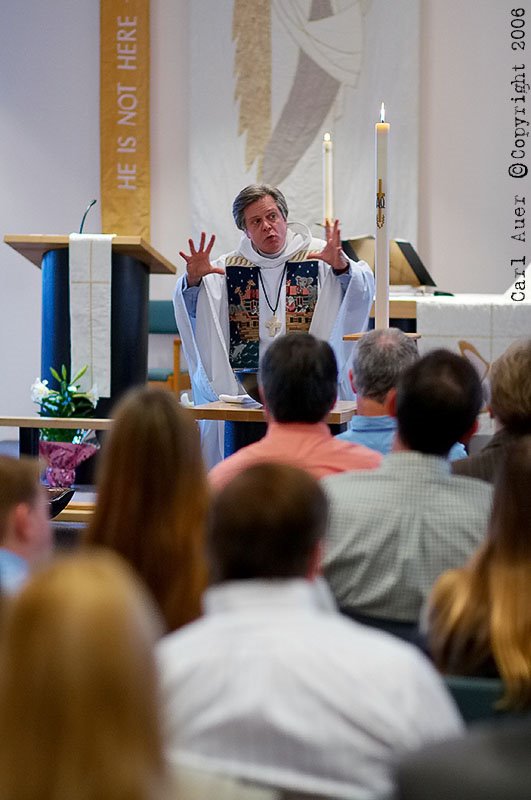
Easter Sunday

April 16th, 2006: Eagle River, AK - Pastor Martin Eldred of Joy Lutheran Church in Eagle River delivers his Easter Sunday Sermon.

Intoduction to Photobag

Welcome to my new blog. I intend Photobag to share photos, photojournalism, tips, tricks, and much more. To start off, let me tell you a little about me. I have been seriously taking photos since my junior year in high school. That was in 1988 in Seattle, Washington. Currently, I am based in South Central Alaska and work as a freelance photojournalist. I freelance for various newspapers all over the state of Alaska, as well as the Seattle Times. I shoot for a world wide sports wire service, Icon SMI and I am represented by the sports photo agency NewSport. I am a senior member of SportsShooter.com and the Sports Corner moderator for www.fredmiranda.com. While my specialty is obviously Sports, I do a lot of stock photography if wildlife (I live in Alaska after all), feature photography, spot news, event, and portrait photography. I have a background in Architectural and Forensic Engineering photography and run a Youth Sports Photography business in the Anchorage area.

I am not a gear head, well, I am, but I do not think the gear you have dictates how good your photographs are. I fully believe, no mater what your gear consists of, as long as you know your gear and its limitations, as well as an understanding of composition and a basic understanding of the subjects you are photographing will yield good photos. However, practice, studying, practice, and more practice along with a strong understanding of photographic styles and a very good knowledge of what you photograph is key in producing great photographs.

My current gear consists of Canon Digital SLR's, a 1D and a Rebel Xt. Along with this I have a variety of Canon lenses, speedlights, strobes. I am Windows based and use PhotoMechanic, PhaseOne Capture One software and Adobe Photoshop CS2.

So, anyway, that is a little about me, and what I want this blog to be. I hope you enjoy.

Carl